Why Kansas matters for wind farm component hauling
Kansas is one of the most important states in the US for wind farm component hauling. It sits in the middle of major wind farm development areas, so enormous turbine blades, tower sections, nacelles, hubs, and other components regularly travel across Kansas highways.
The interesting part is that it is not just "put it on a truck and drive" like ordinary freight. The movement is a planned logistics operation involving a lot of checks, people, and conditions. It usually includes the wind developer, a specialized oversize load carrier, the Kansas Department of Transportation (KDOT), escorts, utilities, law enforcement, and sometimes the local government.
Where wind farm components come from — and what makes them hard to move
A typical Kansas wind farm might source its components from Midwest manufacturers, rail terminals, ports outside Kansas, other wind farms or staging yards, and specialized component manufacturers. These components are then hauled by special tractor-trailer combinations to the wind farm site.
- Turbine blades: Extremely long, often exceeding 200 feet.
- Tower sections: Huge diameter and weight.
- Nacelles: Very heavy and tall.
- Hubs: Heavy but compact.
- Generator components: Concentrated weight.
- Transformers: Weight and dimensions combined.
The blades are usually the most eye-catching part of the convoy, while nacelles and transformers are what actually cause the weight problems.
US-50: Kansas’s wind-hauling corridor
Kansas is particularly important because of US-50 — probably the most interesting Kansas-specific part of this story. KDOT’s freight plan analysis of 2019-2021 oversize/overweight permits found that wind farm components were the largest commodity group moving under permits on US-50.
In fact, wind components accounted for about 64% of the wind farm component permit volume on US-50, representing 25,730 permitted movements. If you are researching the wind farm component hauling industry, US-50 through Kansas is a major corridor worth paying attention to. Think of Kansas as a land bridge between wind component manufacturing and staging areas and wind farms further south and west.
Planning the route: bridges, widths, and turning radii
The carrier plans the route first. This is where the operation gets interesting, because a heavy haul company does not ask "what’s the fastest route?" — they ask "what’s the largest route we can physically get this particular load through?" They investigate bridge weight limits, road widths, overhead clearance, railroad crossings, traffic signals, utility lines, construction, curves and turning radii, intersections, road grades, shoulders, low-clearance structures, and local restrictions.
A turbine blade can be extremely long but light compared to a transformer, so a blade’s route might look completely different from a transformer’s or a heavy nacelle’s.
KDOT permits and K-TRIPS
Kansas requires special permits for vehicle/load combinations exceeding normal size or weight limits. The permit specifies the vehicle and load, the authorized route, and the conditions for movement. Kansas currently handles oversize/overweight permitting through K-TRIPS — the Kansas Trucking Routing Intelligence Permitting System.
A carrier typically submits truck, trailer, turbine component, dimensions, weight, origin, and destination through K-TRIPS/KDOT and receives an approved route with conditions. The permit is not just permission to be oversized — it is effectively a set of instructions for how that particular load is allowed to travel.
Superloads: when a bridge analysis is required
The bigger the load, the more complicated it becomes. Kansas has different permit categories, and one particularly important category for wind and energy logistics is the superload. Kansas regulations define a superload as an overweight load exceeding 150,000 lb gross weight. Superloads require a permit incorporating a bridge analysis performed by KDOT before the movement can travel on Kansas highways.
That is a big deal. Imagine a turbine component weighing 170,000 to 250,000-plus pounds. KDOT cannot simply say "looks good, send it" — they have to determine whether the bridges along the proposed route can safely handle the configuration.
Escort convoys
This is where the classic convoy appears. Depending on the dimensions and permit conditions, the movement can involve a lead escort, the tractor/trailer, and a rear escort. The Kansas Highway Patrol says that superloads, large structures, and loads exceeding 14 feet in width require escort vehicles, and escort providers must be registered with KDOT.
- Traffic management
- Warning approaching motorists
- Navigating intersections
- Monitoring clearances
- Communicating with the truck
- Coordinating difficult turns
Importantly, the Kansas Highway Patrol itself does not provide the escort vehicles — commercial escort providers handle that role.
Utility coordination and operating windows
Utilities can become a major issue, especially for wind turbines. A load can be 15-plus feet wide, 15-plus feet high, and hundreds of feet long — now imagine an overhead utility line crossing the road. The carrier may need to coordinate with the utility company to temporarily raise a line, disconnect a line, move equipment, or monitor the crossing. For particularly large wind components, utility-line coordination can be one of the most critical pieces of the route plan.
These convoys also do not drive whenever they want. Kansas imposes operating restrictions on permitted oversize loads: for vehicles exceeding width or length limits, Kansas law generally prohibits operation from 30 minutes after sunset to 30 minutes before sunrise, unless another authorization applies. They also cannot operate when visibility is below half a mile, or when highway surfaces have ice, snowpack, or drifting snow. That means a wind-turbine convoy may have a very specific operating window — sunrise, convoy begins, several hours of highway movement, fuel/rest/traffic-control stops, arrival at the destination or staging yard, then the next permitted movement. It is much closer to a scheduled logistics project than ordinary trucking.
The full ecosystem behind one oversize load
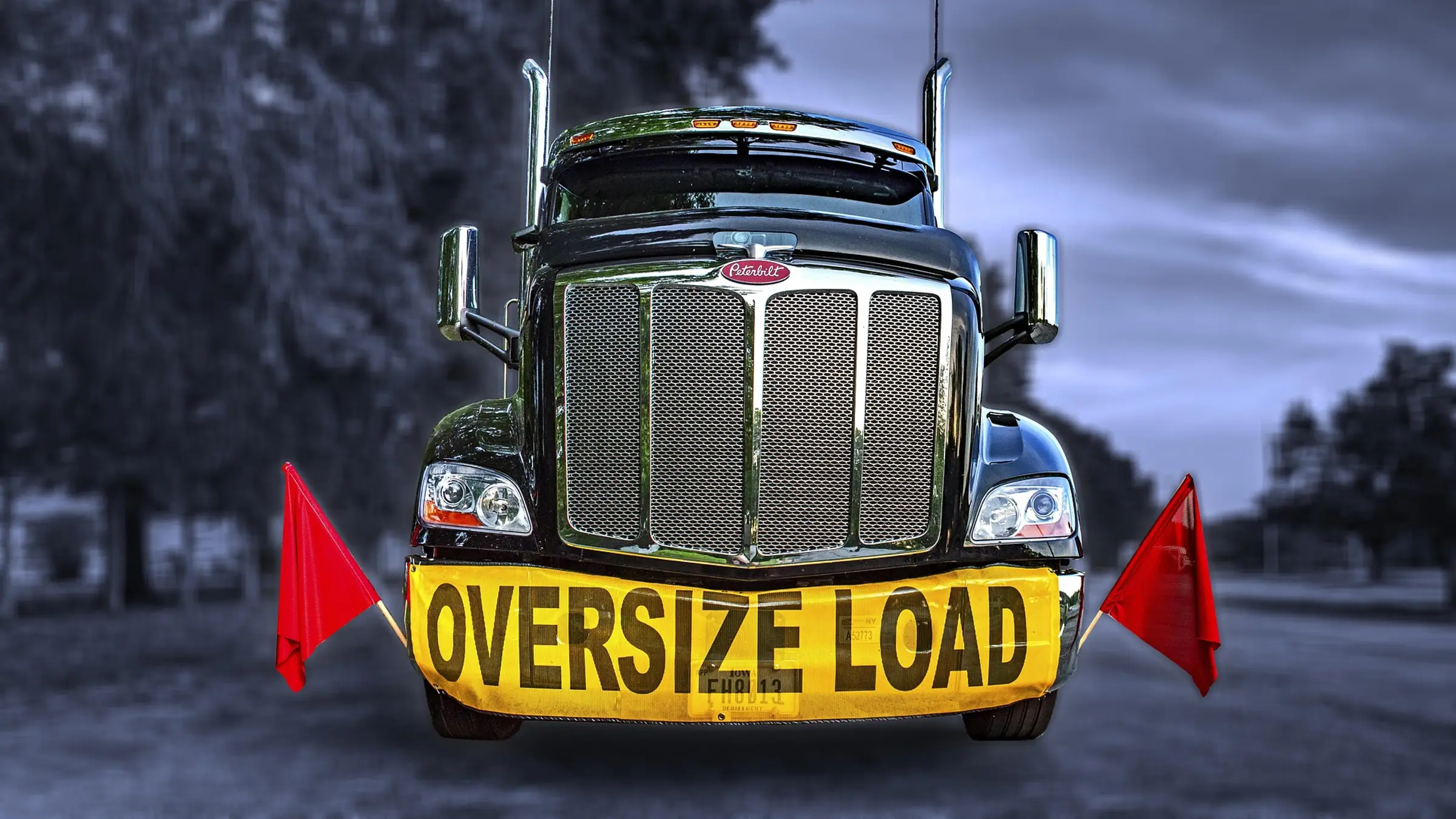
The "Oversize Load" truck you see on the highway is only the visible part. A single turbine movement can involve an entire ecosystem: the wind developer, a logistics/transportation contractor, the heavy-haul trucking company, permit and route specialists, KDOT, escort companies, utility companies, local authorities and law enforcement, and the wind-farm construction crew. That is why wind-component transportation is such an interesting trucking niche.
What makes Kansas especially attractive for this business
- Massive wind resource: Western and central Kansas have enormous wind potential, which has driven substantial wind development.
- Central geographic position: Kansas connects major portions of the Midwest and Great Plains.
- Major east-west corridors: Routes such as US-50 and I-70 are important pieces of the regional transportation network.
- Open land: Compared with dense metropolitan regions, Kansas has long stretches of rural highway where enormous components can be transported.
- Continuing wind construction and repowering: Beyond new wind farms, older turbines eventually need components replaced, upgraded, or removed — creating another heavy-haul market.
Frequently asked questions
What is a superload in Kansas?
A Kansas superload is an overweight load exceeding 150,000 lb gross weight. It requires a permit that includes a bridge analysis by KDOT before the load can travel on Kansas highways.
Do wind turbine loads need an escort in Kansas?
Yes. Kansas Highway Patrol requires escort vehicles for superloads, large structures, and any load exceeding 14 feet in width. Escort providers must be registered with KDOT.
What permitting system does Kansas use for oversize loads?
K-TRIPS — the Kansas Trucking Routing Intelligence Permitting System — is how carriers submit truck, trailer, component, dimension, weight, origin, and destination information to KDOT for an approved route and conditions.
When can oversize wind farm loads legally drive in Kansas?
Generally only between 30 minutes before sunrise and 30 minutes after sunset, and never when visibility is below half a mile or the highway has ice, snowpack, or drifting snow.
Why is US-50 significant for wind component hauling?
KDOT’s 2019-2021 freight plan analysis found wind farm components were the largest commodity group on US-50 oversize/overweight permits — about 64% of wind-component permit volume, representing 25,730 permitted movements.